Understanding Aluminium Welding Rod Grades Before You Specify a Job
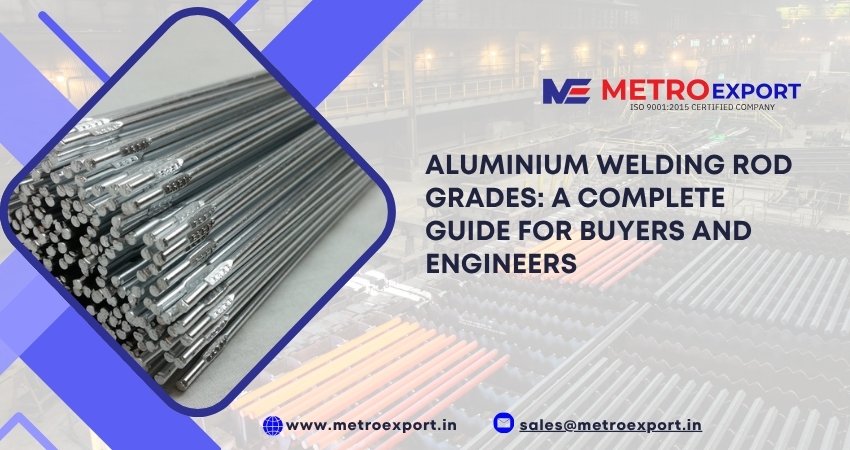
An Aluminum Welding Rod is only as good as its fit with the base metal it joins, and that fit depends entirely on grade. Steel can use a wide range of general-purpose electrodes, while aluminium alloys behave very differently when heated; therefore, the filler rod must be selected alloy by alloy. If you get this detail wrong, you can get hot cracking, poor corrosion resistance, or a joint that simply cannot handle the load it was designed for. For personnel who make bulk filler-metal purchases, and for engineers who develop weld procedure specifications, it can be the difference between a production run and a rejected batch. This guide explains the different types of Aluminium Welding Rods, how they differ, and how to pick the right type for your project.
Key Takeaways
- Aluminium welding rod grades are designated by AWS A5.10; this is the grade for the weld rod and the base alloy family, not just the word “aluminium” in general.
- ER4043 (aluminium-silicon) and ER5356 (aluminium-magnesium) are used for most general fabrication requirements, and they cannot be interchanged.
- Marine, structural, and pressure-vessel applications usually call for higher-magnesium grades like ER5183 or ER5556.
- Strength, corrosion exposure, service temperature, and post-weld anodizing all influence which grade is correct.
Why Aluminium Welding Rod Grades Matter for Industrial Buyers?
Aluminium alloys are classified into 1xxx, 3xxx, 5xxx, 6xxx, and 7xxx according to their alloying elements, and each responds differently to welding heat. A 6061 bracket may be a good choice for the rod, but it may not be the right fit for the 5083 boat hull or the 7075 aerospace fitting. Choosing the wrong aluminium welding rod grade is not merely a cosmetic issue. It can result in loss of joint strength, stress corrosion cracking, or welds that fail inspection based on radiographic or dye-penetrant tests.
For buyers with multiple projects to procure, this is also a cost question. Higher-alloyed rods like ER5183 are more expensive per kg than a generic ER4043 rod; therefore, using a higher-alloyed rod when not necessary is an unnecessary expense. Specifying a sub-size grade, on the other hand, results in a liability. The correct aluminium welding rod grade for the first time solves both problems.
Common Aluminium TIG Welding Rod Grades Explained
Most industrial aluminium welding, whether TIG or MIG, falls under a handful of AWS A5.10 classifications. Here’s how the commonly used grades compare:
| Grade | Alloy Family | Typical Base Metals | Best Suited For |
| ER1100 | Nearly pure aluminium | 1060, 1100, 1350 | Tanks, chemical process equipment, parts needing excellent colour match |
| ER4043 | Aluminium-silicon (~5% Si) | 3003, 5052, 6061, 6063, cast alloys | General fabrication, automotive parts, appliance bodies |
| ER4047 | Aluminium-silicon (~12% Si) | 6061, 6063, castings | Thin sections, brazing-adjacent joints, sealing applications |
| ER5356 | Aluminium-magnesium (~5% Mg) | 5052, 5083, 5086, 6061 | Structural fabrication, trailers, marine frames |
| ER5183 | Aluminium-magnesium (higher Mg/Mn/Cr) | 5083, 5086, 5456 | Marine hulls, pressure vessels, high as-welded strength needs |
| ER5556 | Aluminium-magnesium (highest Mg) | 5154, 5254, 5454, 5456 | Maximum tensile strength, structural welds needing extra ductility |
Each of these Aluminium Welding Rod grades has a specific chemistry, and that chemistry should determine the choice of rod, not the colours or packages. Different suppliers use different colour codes, so procurement teams should confirm the AWS classification stamped on the rod or printed on the spool box.
ER4043 Welding Rod vs ER5356 Welding Rod: The Two Workhorses
In most fabrication shops, you are likely to have to choose from two grades. ER4043 is the aluminium-silicon variety; it flows well, resists hot cracking, and produces a clean, forgiving weld pool, so it is usually the standard for general-purpose welding. The aluminium-magnesium version, ER5356, gives up some of that fluidity for a significant increase in shear strength and corrosion resistance in moist and marine environments.
A few practical distinctions worth knowing:
- Strength: ER5356 offers close to double the shear strength of ER4043, making it the better pick for load-bearing structural joints.
- Corrosion resistance: ER5356 holds up better against saltwater and chemical exposure, which is why boat hulls and marine frames lean on it.
- Finish after anodizing: ER4043 tends to anodize a light grey, blending reasonably well with the base metal, while ER5356 anodizes darker and shows more contrast.
- Ease of use: ER4043’s fluidity makes it more forgiving for less experienced welders, while ER5356’s stiffer wire feeds more consistently through MIG guns without bird-nesting.
Neither grade is a universal substitute for the other. A weld procedure that has been developed for 5083 plate should not be ‘borrowed’ for ER4043 filler simply because it is cheaper or available.
How to Choose the Right Aluminium Welding Rod Grade?
So picking the right grade reduces to a quick checklist which procurement and engineering teams can use for each project:
- Match the base metal series. 5xxx base metals may be welded with 5xxx filler metals (ER5356, ER5183, ER5556); 6xxx base metals are welded using ER4043 or ER5356, depending on the required strength.
- Check the strength requirement. Most decorative or light-load applications require only ER4043, while most structural, load-bearing, or safety-critical joints require the 5xxx series.
- Account for the service environment. Higher-magnesium rods are preferred when exposed to saltwater, industrial chemicals, or sustained damp conditions; note that ER5183, ER5356, and ER5556 are not recommended for sustained elevated-temperature service.
- Confirm the AWS classification, not just the colour. Always check the AWS A5.10 designation on the stamped rod before using it.
- Consider post-weld appearance. If the part is to be anodised and will be seen, consider the desired anodised colour early in the grade selection process, rather than after the weld is complete.
If your project is not just about the filler rod but also the base aluminium bar/plate stock, it’s also a good idea to look at how the base aluminium bar/plate stock is selected too; our guide on how to select the right aluminium bar for your project covers that groundwork, and our aluminium alloy round bar guide goes deeper into how alloy series influence decisions on the fabrication of your project.
Aluminium Welding Rod Grades for Marine, Structural and High-Strength Work
The earlier general-purpose grades apply to most fabrication shops, while marine, structural and pressure-vessel jobs go up the magnesium ladder. ER5183 has been designed to provide maximum as-welded strength on high-magnesium alloys such as 5083; hence, shipbuilders and offshore equipment fabricators specify it for joints requiring a guaranteed minimum strength. ER5556, with the highest magnesium content in common use, is selected where ductility under load is also important, as well as raw strength; however, because of the increased magnesium content, it is not suitable for parts expected to endure extended periods of heat above approximately 150°F.
If a buyer is ordering the rod and base aluminium product, for example, aluminium alloy sheet or aluminium round bar, it is easier for the buyer to maintain the same documentation of the quality of the product to be joined in the weldment.
Conclusion
Aluminium welding rod grades are not just a spec-sheet detail, but a crucial factor that determines whether a weld will be as strong, corrosion-resistant, and visually acceptable as expected. ER4043 and ER5356 are the materials most commonly used for general fabrication, while ER1100, ER4047, ER5183, and ER5556 fill the gap for pure-aluminium colour matching, brazing-style joints, and high-strength marine and structural applications. The consistent rule across all of them: match the rod’s alloy family to the base metal, verify the AWS A5.10 classification directly on the product, and weigh strength and environment before cost.
FAQs
Q1. Which aluminium welding rod grade is best for general-purpose fabrication?
ER4043 is the most widely used general-purpose welding wire for aluminium TIG and MIG welding because it produces smooth weld pools and is hot-crack resistant with most 3000, 6000, and 6000 series aluminium base alloys.
Q2. Can I use ER4043 instead of ER5356 on 5083 aluminium plate?
It isn’t recommended. ER4043 is not as strong in shear and not as resistant to corrosion as the 5xxx-series base metals, such as 5083, require, especially for marine or wet-service applications, so ER5356 or ER5183 is the more appropriate choice.
Q3. What does the ER number on an aluminium welding rod actually mean?
The number refers to the AWS A5.10 classification for the rod’s alloy chemistry; for instance, ER4043 is an aluminium-silicon filler, and ER5356 is an aluminium-magnesium filler, so the ER number identifies the base metals it’s designed to match.
Filler rod selection only works if the base aluminium stock is correct too. Get in touch with our team at sales@metroexport.in or visit our contact page to discuss aluminium bar, sheet, and plate stock for your next welding project.