
Why Titanium Fasteners Are Transforming Modern Aerospace Engineering?
The structural integrity, performance, and long life of the aircraft have been put at the forefront of the aircraft industry, which is currently very demanding due to the use of titanium fasteners in the Aircraft Manufacturing industry. The work of aircraft is intensive, i.e., high pressure, variation in temperature, and constant vibration, and therefore, the requirement of fastening materials to be included in the selection. Titanium Fasteners can be chosen as an inbuilt source due to the fact that it is good in both mechanics and chemistry.
Commercial airliner manufacturers are increasingly embracing titanium fasteners during the weight reduction process, without compromising strength. This article covers the advantages of using titanium fasteners, their applications, and how they compare to the common materials used in aircraft manufacturing.
What are Titanium Fasteners?
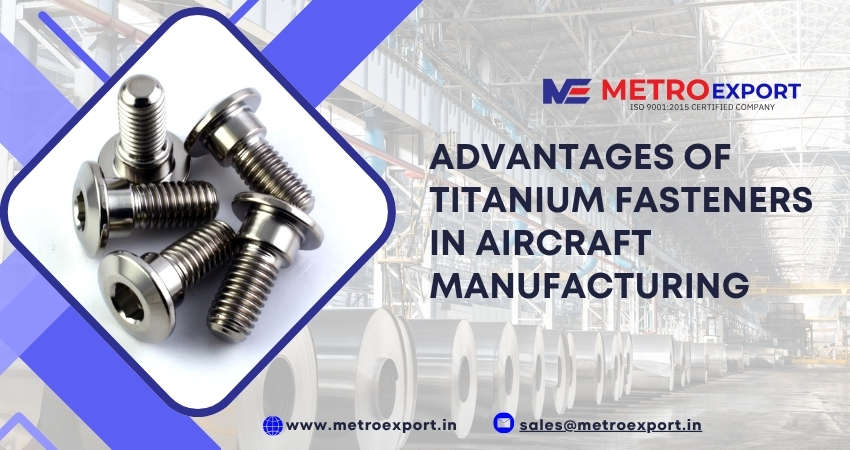
Titanium fasteners are bolts, nuts, screws, washers, or rivets made from titanium and titanium-based alloys with performance specs that exceed those of competing materials. They are common, widely used, in various aircraft manufacturing applications due to their light-weight strength and high corrosion resistance, long service life, and heat resistance:
- Light-weight, yet high-strength performance.
- Excellent corrosion resistance
- Stable at high temps
- Outstanding fatigue resistance
- A long service life is assured in the aerospace applications.
Major Advantages of Titanium Fasteners in Aerospace Applications
1. Superior Strength with Lightweight Performance
High strength and low density of the titanium fasteners are two of the greatest benefits of the fasteners.
- Titanium is close to 45% lighter than steel
- Offers comparable or higher strength
- Reduces overall aircraft weight, improving fuel efficiency.
This renders titanium an excellent decision to the present-day aircraft, in which minimization of weight is directly connected to the cost of operation.
2. Exceptional Corrosion Resistance
Moisture, varying atmospheric pressure, air with lots of salt, and difficult surroundings occur continuously during aircraft operation. Our titanium fasteners get a naturally formed protective oxide coating, which is naturally resistant to corrosion and oxidation in harsh aerospace environments.
- Demonstrates good performance in damp and coastal environments
- Designed for use in a variety of climates.
- Helps minimize maintenance requirements and replacement frequency
These anti-corrosion qualities ensure that titanium fasteners are extremely trustworthy for exterior portions of aircraft and other elements exposed outdoors.
3. High Temperature Resistance
Extreme heat is caused by aircraft engines and the high velocity of the flight. Titanium fasteners do not lose their mechanical properties when subjected to heat.
- Stable performance up to 600°C
- Suitable for engine compartments and exhaust systems
- Prevents structural failure under thermal stress
4. Excellent Fatigue Resistance
Components of aircraft are under continuous load during takeoffs, flight, and landing. Fittings made of titanium resist this repeated stress far better than conventional fastener materials.
- It is possible to load it several times, and the damage would not take place.
- Increase aircraft lifespan
- Enhance overall safety
5. Compatibility with Composite Materials
The modern aircraft is more dominated by carbon fiber, which is a high-technology composite material. Such materials are rather compatible with titanium.
- Prevents galvanic corrosion
- Ensures long-term joint stability
- Widely used in next-generation aircraft structures
Titanium Fasteners Applications in Aircraft
The applications of titanium fasteners in aerospace are extensive and critical:
- Airframe structures: fuselage, wings, and landing gear
- Jet engines: high-temperature fastening
- Hydraulic systems: corrosion-resistant joints
- Avionics and interiors: lightweight fastening solutions
Their versatility means titanium fasteners are used consistently across nearly every major aircraft system.
Comparison: Titanium vs Other Fastener Materials
| Property | Titanium Fasteners | Stainless Steel Fasteners | Aluminum Fasteners |
|---|---|---|---|
| Strength | Very High | High | Moderate |
| Weight | Low | High | Very Low |
| Corrosion Resistance | Excellent | Good | Moderate |
| Temperature Resistance | Excellent | Moderate | Low |
| Fatigue Resistance | High | Moderate | Low |
| Cost | Higher | Moderate | Lower |
Why Aircraft Manufacturers Prefer Titanium Fasteners?
- Fuel efficiency requirements
- Stringent safety standards
- Need for long-lasting materials
- Compatibility with advanced aerospace designs
The future technology of aircraft is also concerned with titanium, as it is critical to the realization of the performance and sustainability objectives.
Conclusion
The use of Titanium Fasteners has revolutionized the aircraft manufacturing industry, insofar as strength, ease of operation, and withstanding the rough conditions are concerned. They have become a very vital element of aerospace engineering in the contemporary world because of their capability to enhance fuel efficiency, save on maintenance and enhance safety.
The upfront cost is higher, but the long-term gain of titanium fasteners outweighs the initial investment. Critical aerospace applications still require titanium as a material of choice because it is reliable and efficient in one of the most demanding industries in the world.
FAQs
Q1. Can titanium fasteners perform reliably in extreme aerospace environments?
Yes. Titanium fasteners maintain outstanding dimensional stability under extreme pressure, vibration, and temperature fluctuations. They hold up in tough operating conditions where traditional fastening materials might fatigue, warp, or corrode.
Q2. Why do aircraft manufacturers prioritize titanium fasteners over heavier alternatives?
Saving even a pound or two per flight adds up to significant fuel savings and extra useful load capacity across an aircraft’s service life. Titanium is used for critical structural assemblies because it delivers a secure, tight mounting at a fraction of the weight of steel alternatives.
Q3. Are titanium fasteners suitable for high-vibration aerospace applications?
Yes. Titanium fasteners exhibit strong fatigue resistance and can withstand continuous vibration, pressure change, and cyclic stress, conditions that are common during aircraft operation and at high altitude.
Looking for premium titanium fasteners for aircraft manufacturing? Contact us or email us at sales@metroexport.in today for customized aerospace fastening products and quick quotes.