
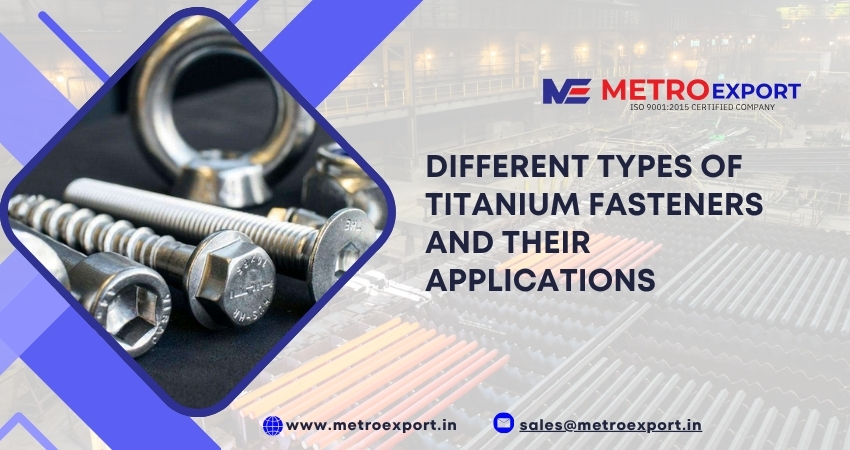
Why Titanium Fasteners Are Transforming Modern Engineering?
Types of titanium fasteners are increasingly becoming the most preferred in high-performance industries due to their superior strength-to-weight ratio, corrosion resistance, and durability. From aerospace engineering to marine design and motorsports, titanium fasteners have a rare blend of reliability and efficiency not usually found in conventional materials.
In some modern-day intensive applications, where performance and life cycle are essential, the choice of fastener can have a profound effect on system integrity. This paper discusses the different kinds of titanium bolts and screws, their intended purposes, and their comparisons with other products, such as stainless steel. Whether you are sourcing titanium machine screws or custom titanium fasteners, this guide will help you make informed decisions.
Exploring the Different Types of Titanium Bolts and Screws
Titanium fasteners exist in numerous shapes and are specific to mechanical and structural requirements. The most popular ones are listed below:
1. Hex Bolts
The hex bolts are commonly employed in construction and heavy industry. Their head is six-sided with easy tightening using standard tools.
Uses: Aerospace, automotive, and industrial structures.
2. Socket Head Cap Screws
They have a cylindrical head and are secured with an Allen key, which is why they are perfect for tight spaces.
Uses: Accurate equipment, robotics, and performance automotive parts.
3. Titanium Machine Screws
Titanium machine screws are designed to be used in joining metal components and are typically used in applications where threading and precision are necessary.
Uses: In electronics, instrumentation, and lightweight assemblies.
4. Stud Bolts
The stud bolts are threaded at both ends and are normally placed with nuts on both sides.
Applications: Flange connections in oil and gas, marine and chemical processing industries.
5. Countersunk Screws
These screws are embedded in the surface, which provides a smooth surface and lessens aerodynamic drag.
Uses: Aerospace panels, racing cars, and marine hardware.
Types of Titanium Fasteners and Their Applications
| Type of Titanium Fastener | Key Features | Primary Applications |
| Hex Bolts | High strength, easy installation | Aerospace, construction |
| Socket Cap Screws | Compact, high torque | Automotive, robotics |
| Machine Screws | Precision threading | Electronics, instruments |
| Stud Bolts | Double-ended threading | Oil & gas, marine |
| Countersunk Screws | Flush finish | Aerospace, racing |
Understanding Grade 5 Titanium Bolts and Other Grades
The grade of material is an important factor when choosing fasteners. The most frequently used are Grade 5 titanium bolts (Ti-6Al-4V), as they have better strength and resistance to heat.
- Grade 2 Titanium: Grade 2 is a commercial grade with high corrosion resistance and low strength.
- Grade 5 Titanium: Contained aluminium and vanadium, which is high-strength and fatigue-resistant.
Grade 5 is commonly used in critical load-bearing applications, notably in aerospace and motorsports.
Titanium vs Stainless Steel Fasteners: Which Performs Better?
The titanium vs. stainless steel fasteners debate usually hinges on the application needs.
Advantages of Titanium:
- As light as 40% of steel.
- Outstanding corrosion resistance (particularly in salt water)
- Non-magnetic and biocompatible
The benefits of stainless steel:
- Lower cost
- Easier availability
- Strength: good general.
However, stainless steel is good in most situations; titanium is the best where weight loss and corrosion resistance are of utmost importance.
Custom Titanium Fasteners for Specialized Needs
Off-the-shelf fasteners in most industries may not be suitable for particular design requirements. This is where bespoke titanium fasteners come in.
Manufacturers can tailor the following:
- Dimensions and threading
- Surface finishes
- Strength specifications
Custom solutions are particularly valuable in aerospace and defense, where precision and performance cannot be compromised.
Conclusion
The selection of the appropriate type of titanium fastener is necessary to maximize the performance, durability, and efficiency. Engineers have multiple choices, such as hex bolts, socket screws, and titanium machine screws, to pick the fasteners that are accurate to the application requirements.
Since grade 5 titanium bolts are applied in aircraft engines and titanium fasteners are corrosion-resistant in the sea, titanium still dictates what can be done in the current engineering environment. It is lightweight and highly strong, thus making it the best option in industries where performance is very important.
FAQs
Q1. What are the main benefits of using titanium fasteners?
Titanium fasteners are very strong in terms of weight-to-weight ratio, have great corrosion resistance, have a long life, and are non-magnetic, thus being suitable for harsh environments.
Q2. Titanium vs stainless steel fasteners: Which is better?
Titanium is preferred in cases where there is a need for lightweight and corrosion resistance, whereas stainless steel is cheaper to use.
3. How much weight do titanium bolts save?
Compared to steel fasteners, titanium bolts can be about 40% lighter, which is important in aerospace and racing.
Looking for reliable, high-strength fastening solutions? Contact us or email us at sales@metroexport.in fastener experts today to get a quote on custom titanium fasteners, titanium bolts and screws, and precision-engineered components tailored to your application.