
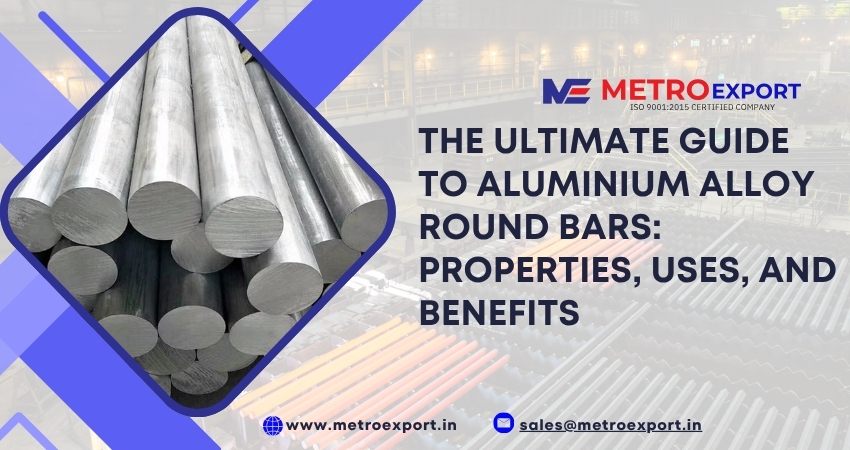
Why Are Aluminium Alloy Round Bars Essential in Modern Engineering?
The reason is that Aluminium Alloy Round Bar are being used in a majority of contemporary engineering in the sense that they provide the rational equilibrium of strength, minimal weight, and great corrosion resistance. They find applications in any number of industries where weight is a critical consideration. They can be used in both highly specialised parts and large structural elements.
In the world of modern engineering, the choice of material can play a pivotal role in enhancing performance, durability, and cost efficiency. Aluminium Alloy Round Bar provide a reliable answer to problems in high-temperature, wet, and corrosive operating environments. They provide a combination of properties that engineers, technicians, and manufacturers need for reliable performance and responsibilities.
Understanding Aluminium Alloy Round Bar Properties
Aluminium alloy round bars are a far cry from pure aluminium bars: they’re alloys, produced when certain elements – such as copper, magnesium, silicon, or zinc – are blended with aluminium. This process introduces a grain structure that enhances the mechanical properties, wear resistance, and corrosion resistance of aluminium.
Key Properties:
- Lightweight: Provides a substitute for steel that doesn’t add weight
- High Load-Bearing: Offers excellent load-bearing without added weight
- Corrosion Resistant: Suitable for marine and humid environments and chemicals
- Good Thermal Conductivity: Heat can be dissipated if required
- Easy to Fabricate: Forms into cast, machined, and fabricated forms
These characteristics make aluminium alloy round bars suitable for use in structural applications and in engineering applications that require precision and customer satisfaction.
Aluminium Alloy Round Bar Grades and Specifications
The choice of Aluminium Alloy Round Bar is not simply a matter of size but a matter of putting the performance of the material in line with the application requirements. Controlled compositions and processing techniques are used in engineering different grades with different levels of strengths, corrosion resistance, and workability. In the real world of operation, the right grade will promote efficiency, increased lifespan, and lessened maintenance.
Common Grades:
- 6061 Aluminium Alloy: It is a very reliable all-round material that possesses a balance between strength and corrosion resistance, and workability, and is used in general engineering.
- 6063 Aluminium Alloy: It is clean, the surface finish is ideal, and extrusion is preferred, as it has a smooth surface and is used in architectural and aesthetic applications.
- 2024 Aluminium Alloy: Has been developed to be used in high-stress environments where durability and fatigue resistance are important considerations.
- 5083 Aluminium Alloy: It is designed for heavy environments and is mostly used in cases of exposure to seawater and chemicals.
- 7075 Aluminium Alloy: One of the highest-strength aluminium alloys available, developed for demanding structural and aerospace-grade applications where superior strength and fatigue resistance outweigh the need for weldability.
Typical Specifications:
- Diameter Range: It is available in a 5mm to 500 mm diameter range, depending on the needs of using it.
- Length Variations: Can be provided in standard lengths of 3-6 meters or tailored according to project needs.
- Standards Conformance: manufactured in respect of international standards ASTM, EN, DIN, and others.
The success of aluminium alloy round bars will be greatly determined by the type of grade and specification of alloy that is chosen. Proper balance guarantees that there is optimised mechanical performance, durability, and cost efficiency in different industrial applications.
Aluminium Alloy Round Bar Applications Across Industries
Most industries are accepting aluminium round bars due to their versatility, toughness, and resistance to environmental conditions. They make a good selection of material to be used in both structural and functional uses due to their consistency in their behavior under different operating conditions.
Key Applications:
- Aerospace: Intended usage to structural bases, connecting elements, and precision fittings in areas of ultimate consideration to weight saving.
- Automobile: It can be applied in shafts, chassis parts, and even in the suspension systems of the car to make them more efficient.
- Marine: Can be used as ship and boat fittings due to seawater and corrosion resistance.
- Construction: It is applied in construction structures as supports load bearing structures.
- Industrial Machinery: This is primarily in rotating, equipment assemblies, and mechanical assemblies.
These applications demonstrate the flexibility and sustainability of aluminium alloy round bars in challenging industries.
Working Performance Under Different Conditions
Aluminium Round Bars prove highly economical and may continue to be utilised in a variety of conditions. They are able to have high structural integrity in high temperatures with minimal deformation. They can be applied in corrosive environments, such as the marine or chemical industry, with their natural resistance to prevent material degradation. To add to this, they are lightweight and are therefore efficient in dynamic applications requiring minimal loading.
This trend of behaviour in each of these two conditions renders the round bars composed of alloys of aluminium a dependable choice within the existing engineering set of circumstances:
| Condition | Performance Characteristics | Recommended Grade |
|---|---|---|
| High Temperature | Moderate strength loss, good thermal conductivity | 6061 |
| Corrosive Environment | Excellent corrosion resistance | 5083 |
| High Stress/Load | Superior strength and fatigue resistance | 7075 |
| Marine/Saline Conditions | High resistance to seawater corrosion | 5083 |
| Precision Machining Needs | Smooth finish and easy machinability | 6061 |
Aluminium Alloy Round Bar Corrosion Resistance
Among the outstanding benefits of aluminium alloy round bars is that they can withstand corrosion even in tough conditions.
Why It Matters:
- Protective Oxide Layer: This is formed as a natural form of a coating of oxide that just protects the surface of the metals against damage.
- Tough against Adverse Climate: Works in moisture, saline, and chemically contaminated areas.
- Reduced Maintenance Requirement: Minimises the requirement of regular repair or protective treatments.
5083 and 6061 grades are particularly fairly resistant to corrosion and so can last as long as a material used in harsh and exposed environments.
Benefits of Using Aluminium Alloy Round Bars
The combination of performance, durability, and efficiency makes it a preference in modern industries in which aluminium alloy round bars are used in a variety of ways.
Key Advantages:
- Long-Term Reliability: Is able to sustain performance even in difficult and exposed settings
- Cost Effectiveness: Has a low maintenance demand, making the total maintenance and replacement costs low.
- Broad Usability: Applicable in aerospace, automobile, boat, and construction industries.
- Green Alternative: 100% recyclable production material, which promotes the production process.
This makes aluminium alloy round bars an attractive option for engineers and operators.
Conclusion
The main characteristics of Aluminium Alloy Round Bars are their capacity to provide strength with no unnecessary weight, and corrosion resistance that can be considered trustworthy. They can be used in general engineering and in strenuous use, such as in the marine and high-temperature environments, due to their versatility.
Industries can obtain higher structural efficiency, decrease the maintenance effort, and increase the service life by judiciously choosing the appropriate grade and specifications. The alloy types like 6061 and 7075 are especially desirable in their ability to retain their performance and stability even though the temperature is high, and thus, offer a reliable alternative in the most important branches of engineering.
FAQs
Q1. Is it possible to use aluminium alloy round bars outdoors or even in a marine environment?
Yes, they can take outdoor structures and marine work quite well, as they can withstand the weather quite well. They, in most situations, make a natural protective coating that keeps them within their limits even when they are in wet or coastal areas.
Q2. What grade will do best in highly corrosive environments?
When dealing with places that are at risk of exposure to saltwater, chemicals, or constant moisture, 5083 can normally be trusted to work. It is commonplace for materials are likely to be subjected to severe and sustained exposure and still work without rapid deterioration.
Q3. What size range do you usually have? What standards?
They are usually available in diameters from 5 mm to 500 mm round bars, and between 3 and 6 meters in length, or as needed. They are made according to the accepted global standards of ASTM, EN, and DIN in order to guarantee uniform quality.
Need Aluminium Alloy Round Bars ? To get a quick quote, Contact us or email us at sales@metroexport.in today. Send your specification to MetroExport.in and we will help you.